What Are Akoya Pearls? Meaning, Origin and Quality
Understand what Akoya pearls are, whether they are real, where they are grown, and how to compare quality, freshwater alternatives and necklace prices.
Akoya pearls are real saltwater cultured pearls grown in oysters with human intervention. They are associated with classic white or cream strands and bright luster. Japan and China both produce them, so Akoya does not by itself establish Japanese origin. The name describes a pearl type, not a quality grade: compare the actual item’s luster, surface, nacre and matching.
Source basis: GIA · View referencesThis page summarizes information from the institutional sources listed below. Statements attributed to a laboratory, standards body or regulator reflect that source; Pearlpedia's explanatory wording is editorial synthesis, not a substitute for a laboratory report or legal guidance.
What does Akoya pearl mean?
Akoya identifies a type of saltwater cultured pearl. It does not tell you the strand’s grade, its exact origin or whether it has been independently examined. GIA’s pearl description places Akoya among the four major cultured whole-pearl types, alongside South Sea, Tahitian and freshwater pearls.
For a listing labeled “Akoya cultured pearl necklace,” read the words separately: Akoya is the pearl type; cultured means growth involved human intervention; necklace describes the finished jewelry. Ask for origin, treatment and quality information separately.
Are Akoya pearls real or imitation?
Akoya cultured pearls are real pearls that grow in living oysters. Human involvement in cultivation does not make them manufactured imitations. They differ from natural pearls, which form without human intervention. GIA explains that distinction in its guide to pearl types and cultivation. Our natural, cultured and imitation pearl guide explains the terminology used in listings.
A product name alone cannot verify the identity of a particular item. When independent identification matters, ask what the laboratory report covers and whether it matches the jewelry offered.
Do all Akoya pearls come from Japan?
No. GIA identifies both Japan and China as producers. Akoya pearls are generally grown in Pinctada fucata-complex oysters. Japan has a central place in their commercial history, but the word Akoya alone is not proof of Japanese origin. Request the seller’s written origin disclosure if provenance affects your choice.
Typical appearance
Akoya cultured pearls are usually smaller than South Sea pearls. GIA educational material commonly places their typical commercial range around the mid-single digits to roughly 9 mm, although smaller and larger pearls exist.
They are especially valued for:
- round or near-round shapes,
- bright, often sharp luster,
- white to cream bodycolors,
- possible pink, green or other subtle overtones.
High-quality Akoya pearls can produce crisp reflections that give the strand a visually bright appearance.
How they are cultured
Modern round Akoya culture generally uses bead nucleation together with mantle tissue. The oyster deposits nacre over a round shell bead.
Because the nacre grows around a pre-shaped nucleus, nacre quality and thickness are important considerations. Thin or poor nacre can affect both appearance and durability.
Japanese cultured-pearl history
Japan played a central role in the commercial development of round cultured pearls. GIA’s historical material documents experiments by Kokichi Mikimoto and other Japanese innovators around the turn of the twentieth century.
Commercial cultured pearls dramatically expanded pearl availability compared with the much rarer natural-pearl trade.
Akoya or freshwater: which should you compare?
Both are cultured pearls, but they come from different growing environments. Start with the appearance and design you want, then inspect the evidence for individual pieces. Our Akoya versus freshwater comparison explains the choice in detail; neither type name guarantees superior quality.
| Your question | Next guide | What it helps you establish |
|---|---|---|
| Is Akoya the right pearl type for me? | Akoya vs. freshwater | Differences to consider before comparing necklaces. |
| What makes this strand good quality? | Seven pearl value factors | A shared vocabulary for assessing the actual pearls. |
| Does AAA mean the same at every store? | Pearl grading systems | Why seller grade definitions need to be read separately. |
| How much should I expect to pay? | Pearl necklace cost guide | Dated examples with their dimensions and construction. |
How much do Akoya pearls cost?
There is no single price for an Akoya pearl necklace. Compare the chosen configuration: pearl diameter, finished length, full strand versus spaced pearls, clasp metal and the evidence offered for quality. The cost guide and Akoya necklace comparison provide dated retailer examples. They are research snapshots, not a current market average or a guarantee of availability.
Buying Akoya pearls
Do not assume that every Akoya strand is equivalent simply because it is labeled Akoya. Compare:
- luster,
- surface,
- nacre quality,
- matching,
- shape,
- size,
- color and overtone.
Retailer grades such as A, AA, AAA or proprietary labels are not automatically comparable between sellers. The actual visible and documented characteristics matter more than the letters alone.
Match the necklace before comparing the grade
A useful online comparison starts with the same type of jewelry. A full strand, a necklace with spaced pearls on a chain and a single-pearl necklace contain different amounts of pearl and metal. Our dated Akoya necklace comparison separates these constructions and identifies selected configurations, unresolved prices and unavailable listings.
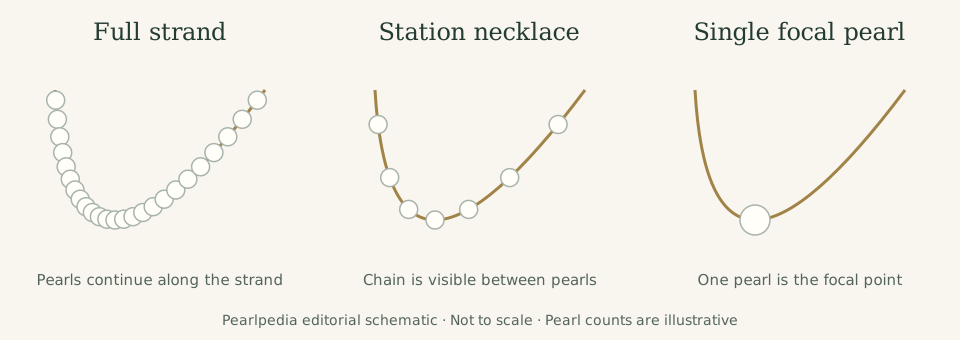
Pearlpedia schematic, not product photography; pearl counts are illustrative.
| Your decision | Information to match | Why it changes the comparison |
|---|---|---|
| How prominent should the pearls look? | Actual diameter range in millimeters | A 4.0–4.5mm strand is visibly different from a 7.0–7.5mm strand; a brand label does not make their sizes comparable. |
| Where should the strand sit? | Exact finished length | A 16-inch base price and an 18-inch quote describe different configurations. Try the length on your own neck rather than relying on a style name. |
| Which construction do you want? | Full strand or spaced pearls, and pearl count if stated | A 13-pearl station necklace is an alternative design, not automatically a cheaper equivalent to a continuous strand. |
| What is the clasp made of? | Solid-gold purity, sterling silver, gold-filled or another stated material | Similar photographs and gold color do not establish identical metal. |
| What supports the quality description? | Luster, surface, matching, shape and nacre evidence | A seller’s AAA label is not an item-specific laboratory result. |
These are comparison instructions, not claims that a particular listed item has passed a Pearlpedia inspection. For the gemological framework, see GIA’s Pearl Quality Factors and our seven-factor buying checklist.
AAA and Hanadama: ask what evidence comes with the item
Start with the seller’s own definitions. Our four-retailer grading comparison records different approaches to surface, luster, nacre and matching; it does not translate one merchant’s letters into another’s.
If Hanadama is advertised, ask which laboratory issued the report and whether its number and item description match the strand you will receive. Do not infer a measured nacre thickness from a letter grade, a white color, a high price or a seller certificate of authenticity. Read what laboratory reports can establish when a report is important to your decision.
What to request before ordering
- The exact pearl diameter, finished length, clasp material and selected variant.
- Photographs or video of the actual strand, with the seller explaining the lighting and any visible surface features. Stock photographs alone cannot establish the condition of the item you receive.
- Written origin and treatment disclosures, plus the scope of any laboratory report offered.
- A quote for that configuration, including currency, shipping, taxes and potential duties.
- The return deadline, its starting event, required authorization and any exclusion for customization or clasp changes.
If the seller cannot document a detail, keep it as unknown rather than converting the absence into a quality score. For a first comparison, use the Akoya vs. freshwater guide alongside the two dated necklace comparisons.